Goat River Watershed Water Sustainability Planning
Overview
Water Sustainability in the Goat River Watershed
The Regional District of Central Kootenay (RDCK) in collaboration with yaqan nuʔkiy, is doing water sustainability planning to respond to growing concerns about water availability in the Goat River Watershed (includes the communities of Canyon, Erickson, Kitchener, Lister, Town of Creston, West Creston, Wynndel, and yaqan nuʔkiy). This effort aims to protect the health and resilience of the local watersheds that support communities, ecosystems, and economies.
This page will keep you informed about the project’s progress and provide opportunities to participate through surveys, conversations, and events. Your input will help shape a locally grounded approach to watershed sustainability that reflects the values and needs of the region.
Scroll down to take our Water Values Survey and see when an Open House is coming to your community!
The Engagement Approach
This work is grounded in Ktunaxa values, including ʔakxamis q̓api qapsin (all living beings), ʔukiniⱡwitiyaⱡa (many people working with one heart), and ʔit̓qawxawiȼikimik (everyone holds this belief together). It reflects a shared commitment to respectful relationships, deep listening, and collaborative solutions that consider both Indigenous and local knowledge systems.
We’re inviting the public, interest groups, and local leaders to take part in a series of conversations, campaigns, and storytelling activities. Engagement will unfold over four phases:
Phase 1: Listening and Learning—Survey open now!
We begin by opening a space for reflection and dialogue. The Water Values survey invites you to share how you feel about the state of water and your personal observations. The goal is to listen and learn from a wide range of experiences and voices. Our team will be at community events, including the Creston Valley Fall Fair and the Creston Farmers Market on September 27. Stop by our booth to learn more about this initiative, pick up a copy of the survey, and share what you’ve noticed about local water.
Phase 2: Exploring the Big Picture
We will create and share educational tools to help us understand key issues and trends. These materials will be featured at open houses in Canyon, Erickson, Kitchener, Lister, the Town of Creston, West Creston, and Wynndel.
Each open house will start with a drop-in session where you can explore the information displays about local water challenges, project goals, and watershed data.
About an hour in, there will be a short presentation to summarize this information, followed by a discussion period where you can ask questions and share your thoughts. Your input matters. See when we’ll be in your community and join the conversation at an upcoming open house:
- Oct 22, 5:30–7:30 PM—Wynndel Community Centre (Presentation at 6:30 PM) In Arts Centre room
- Oct 23, 7:00–9:00 AM—West Creston Community Hall (Presentation at 8:00 AM)
- Oct 25, 9:00–11:00 AM—Creston & District Community Complex CRESTON ROOM (Presentation at 10:00 AM)
- Nov 1, 1:00–3:00 PM—Kitchener Community Hall (Presentation at 2:00 PM)
- *New Date and Time* Nov 10, 5:30 – 7:30 PM—Canyon Community Hall (Presentation at 6:30 PM)
- Nov 12, 5:30–7:30 PM—Erickson Elementary (Presentation at 6:30 PM)
We invite you to share your input on how we can work together toward a shared water future. Refreshments will be provided.
This work is being done with yaqan nuʔkiy and guided by community input throughout. Check back here for updates, tools, and opportunities to get involved, because the future of water is something we all care for together.
Background
All beings in the region are increasingly affected by the impacts and pressures on water systems. In recent years, the area has experienced diminishing water supplies, dry wells, crop losses from heat, flooding, and shifting pest patterns due to milder winters.
In May 2024, yaqan nuʔkiy and the RDCK sent a letter to the Ministry of Water, Land and Resource Stewardship (WLRS) requesting support for this work and expressing interest in creating a Water Sustainability Plan(External link). WLRS responded with support, recognizing the need for a new, collaborative approach to watershed stewardship in the valley.
How To Get Involved

Connectors host conversations with family, friends, or neighbours about water. These kitchen-table discussions are a chance to explore local issues, hear perspectives, and share ideas for action. Explore the Kitchen Table Discussion Guide(External link)

Storytellers share their personal connection to water, whether through memories, observations of change, or hopes for the future. Stories may appear in reports, on social media, or on the RDCK website. Reach out to Camille to set up an interview or share your story over email to cleblanc@rdck.bc.ca(External link)  Contributors share their voice through the Water Values Survey, forums, or conversations. Your input helps build understanding of water sustainability in the Goat River Watershed. You’re also encouraged to join our mailing list(External link) for updates, resources, and future opportunities.
Learners are eager to deepen their understanding of what it takes to build a sustainable water future in the Goat River Watershed. Join our mailing list!(External link)
3D Map
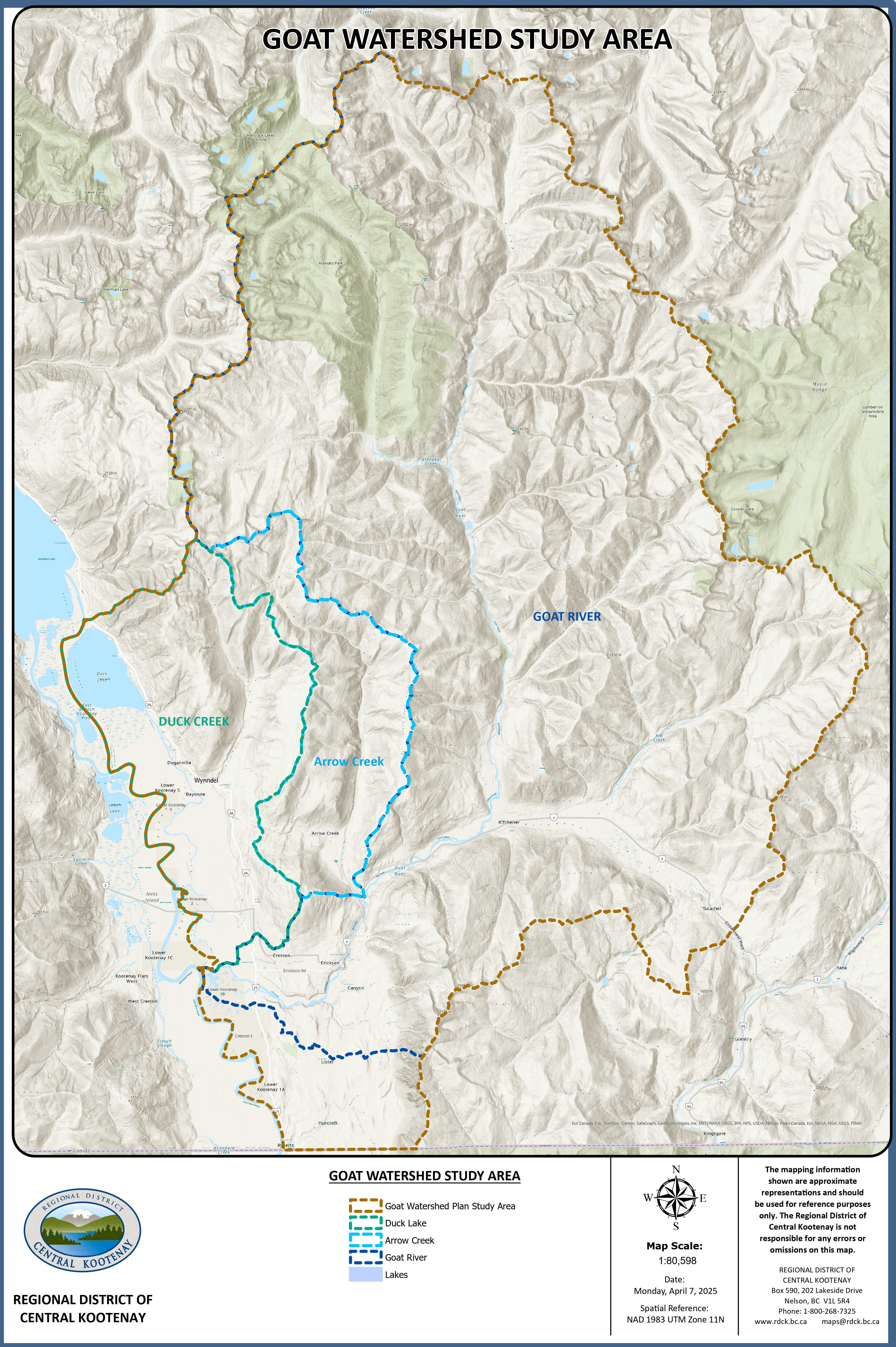
Explore the Goat River Watershed 3D Map! Click on the image below.
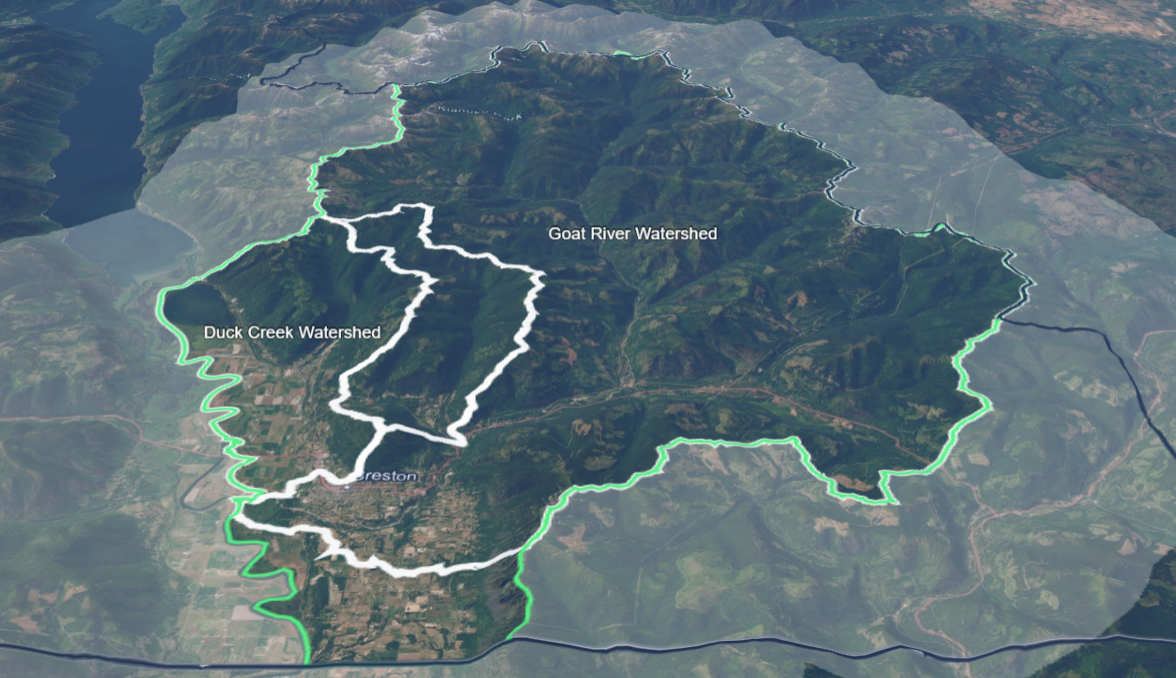
Goat River Watershed Map
Click on the map to explore the study area on the RDCK’s Watershed Governance Initiative Web Map
Frequently Asked Questions
What is a Water Sustainability Plan (WSP)?
A WSP is a planning and governance tool under BC’s Water Sustainability Act. It is developed collaboratively with Indigenous Nations, local governments, and communities to address water challenges such as conflicts between users, risks to water quality, or threats to ecosystem health.
Why would we do a WSP here?
A WSP is considered when there are clear risks or conflicts that can’t be solved by existing tools—such as drought pressures, groundwater declines, or ecosystem damage. It provides a way for governments and communities to work together and create enforceable solutions tailored to the watershed.
What are the benefits of a WSP?
Benefits include:
– Protecting drinking water sources and aquatic ecosystems.
– Building stronger relationships between Indigenous and non-Indigenous governments.
– Bringing all water users—residents, farmers, businesses—into one conversation.
– Developing enforceable regulations that can actually influence land and water use decisions.
– Creating a long-term plan for sustainable water management that reduces conflict and increases certainty.
Who leads a WSP?
A WSP must be co-developed with First Nations whose territories are in the watershed. The Province must also be a partner, since the plan has legislative authority. Local governments may be invited to lead parts of the process. Improvement districts, water users, and community groups are invited to participate in shaping priorities and solutions.
What is the legal power of a WSP?
Once approved by the Minister, a WSP can lead to regulations that are legally binding. These can require decision-makers to consider the plan in issuing permits or land-use decisions, or restrict certain activities that threaten water or ecosystem health. This makes a WSP stronger than voluntary agreements or advisory plans.
How long does it take to develop a WSP?
Developing a WSP is a multi-year effort (at least 3–5 years). It involves issue identification, building partnerships, co-developing the plan, and setting up monitoring and adaptive management.
How is a WSP different from other water or land use plans?
Unlike voluntary watershed plans, a WSP is backed by provincial law. It can result in enforceable regulations, apply to both surface water and groundwater, and require provincial and local decision-makers to follow its direction.
What about forestry?
Forestry is absolutely part of the story of watershed health, activities such as road building, harvesting, and replanting all influence how water moves through the landscape. Disturbance in headwaters can change the timing and amount of flow, increase sediment, and affect water temperature. So it’s important that we understand and monitor those effects. However, a Water Sustainability Plan is not a forestry plan. Under the Water Sustainability Act, a WSP is a water-focused tool used when there are risks to water quantity, water quality, or aquatic ecosystem health, or conflicts between users. Its purpose is to bring governments, First Nations, and communities together to decide how water is managed – who uses it, how much is available, and what measures are needed to sustain environmental flow. The WSP process can identify that upstream land-use activities are contributing to water stress, but it addresses those issues through the lens of water by improving data, setting up flow objectives, and coordinating decisions across agencies. Broader questions about timber supply, forest tenure, or logging approvals remain under the Forest and Range Practices Act and the provincial forest ministry.
What is the reason why the RDCK considers the Goat River a sensitive ecosystem?
The Goat River Watershed is considered a sensitive ecosystem because it provides critical ecological and hydrological functions that directly influence community water supply, fish habitat, and agricultural productivity. The watershed supports surface and groundwater systems that are hydrologically connected to the Canyon (0489) and East Creston/Lister (0488) aquifer, both of which are provincially recognized as at-risk drinking water sources and agricultural supply areas. See a breakdown of the research we are referencing here (page 3)
Has the Creston Valley Alternative Water Supply Feasibility Study considered water quality as well as quantity when assessing the Kootenay River as a potential irrigation source, and has any water quality testing been done?
The Creston Valley Alternative Water Supply Feasibility Study https://engage.rdck.ca/cvstudy examined the technical potential of supplementing irrigation water from the Kootenay River, recognizing that existing allocations from Goat River and Arrow Creek are nearing capacity during low-flow periods.
These findings underscore that further site-specific testing would be required before making a final selection of the Kootenay River as an irrigation source. The study reference can be found here: The Creston Centralized Water Feasibility Study (2025, DRAFT) details these assessments, including flow modelling and source water analysis. [RDCK Draft Report, Feb 2025]
Links
Documents
WSP FAQ Goat River Watershed 2025
Kitchen Table Discussions Guide and Worksheet
Water Sustainability in the Goat River Watershed
The Regional District of Central Kootenay (RDCK) in collaboration with yaqan nuʔkiy, is doing water sustainability planning to respond to growing concerns about water availability in the Goat River Watershed (includes the communities of Canyon, Erickson, Kitchener, Lister, Town of Creston, West Creston, Wynndel, and yaqan nuʔkiy). This effort aims to protect the health and resilience of the local watersheds that support communities, ecosystems, and economies.
This page will keep you informed about the project’s progress and provide opportunities to participate through surveys, conversations, and events. Your input will help shape a locally grounded approach to watershed sustainability that reflects the values and needs of the region.
Scroll down to take our Water Values Survey and see when an Open House is coming to your community!
The Engagement Approach
This work is grounded in Ktunaxa values, including ʔakxamis q̓api qapsin (all living beings), ʔukiniⱡwitiyaⱡa (many people working with one heart), and ʔit̓qawxawiȼikimik (everyone holds this belief together). It reflects a shared commitment to respectful relationships, deep listening, and collaborative solutions that consider both Indigenous and local knowledge systems.
We’re inviting the public, interest groups, and local leaders to take part in a series of conversations, campaigns, and storytelling activities. Engagement will unfold over four phases:
Phase 1: Listening and Learning—Survey open now!
We begin by opening a space for reflection and dialogue. The Water Values survey invites you to share how you feel about the state of water and your personal observations. The goal is to listen and learn from a wide range of experiences and voices. Our team will be at community events, including the Creston Valley Fall Fair and the Creston Farmers Market on September 27. Stop by our booth to learn more about this initiative, pick up a copy of the survey, and share what you’ve noticed about local water.
Phase 2: Exploring the Big Picture
We will create and share educational tools to help us understand key issues and trends. These materials will be featured at open houses in Canyon, Erickson, Kitchener, Lister, the Town of Creston, West Creston, and Wynndel.
Each open house will start with a drop-in session where you can explore the information displays about local water challenges, project goals, and watershed data.
About an hour in, there will be a short presentation to summarize this information, followed by a discussion period where you can ask questions and share your thoughts. Your input matters. See when we’ll be in your community and join the conversation at an upcoming open house:
- Oct 22, 5:30–7:30 PM—Wynndel Community Centre (Presentation at 6:30 PM) In Arts Centre room
- Oct 23, 7:00–9:00 AM—West Creston Community Hall (Presentation at 8:00 AM)
- Oct 25, 9:00–11:00 AM—Creston & District Community Complex CRESTON ROOM (Presentation at 10:00 AM)
- Nov 1, 1:00–3:00 PM—Kitchener Community Hall (Presentation at 2:00 PM)
- *New Date and Time* Nov 10, 5:30 – 7:30 PM—Canyon Community Hall (Presentation at 6:30 PM)
- Nov 12, 5:30–7:30 PM—Erickson Elementary (Presentation at 6:30 PM)
We invite you to share your input on how we can work together toward a shared water future. Refreshments will be provided.
This work is being done with yaqan nuʔkiy and guided by community input throughout. Check back here for updates, tools, and opportunities to get involved, because the future of water is something we all care for together.
Background
All beings in the region are increasingly affected by the impacts and pressures on water systems. In recent years, the area has experienced diminishing water supplies, dry wells, crop losses from heat, flooding, and shifting pest patterns due to milder winters.
In May 2024, yaqan nuʔkiy and the RDCK sent a letter to the Ministry of Water, Land and Resource Stewardship (WLRS) requesting support for this work and expressing interest in creating a Water Sustainability Plan(External link). WLRS responded with support, recognizing the need for a new, collaborative approach to watershed stewardship in the valley.
How To Get Involved
Connectors host conversations with family, friends, or neighbours about water. These kitchen-table discussions are a chance to explore local issues, hear perspectives, and share ideas for action. Explore the Kitchen Table Discussion Guide(External link)
Storytellers share their personal connection to water, whether through memories, observations of change, or hopes for the future. Stories may appear in reports, on social media, or on the RDCK website. Reach out to Camille to set up an interview or share your story over email to cleblanc@rdck.bc.ca(External link) Contributors share their voice through the Water Values Survey, forums, or conversations. Your input helps build understanding of water sustainability in the Goat River Watershed. You’re also encouraged to join our mailing list(External link) for updates, resources, and future opportunities.
Learners are eager to deepen their understanding of what it takes to build a sustainable water future in the Goat River Watershed. Join our mailing list!(External link)
3D Map
Explore the Goat River Watershed 3D Map! Click on the image below.
Goat River Watershed Map
Click on the map to explore the study area on the RDCK’s Watershed Governance Initiative Web Map
Frequently Asked Questions
What is a Water Sustainability Plan (WSP)?
A WSP is a planning and governance tool under BC’s Water Sustainability Act. It is developed collaboratively with Indigenous Nations, local governments, and communities to address water challenges such as conflicts between users, risks to water quality, or threats to ecosystem health.
Why would we do a WSP here?
A WSP is considered when there are clear risks or conflicts that can’t be solved by existing tools—such as drought pressures, groundwater declines, or ecosystem damage. It provides a way for governments and communities to work together and create enforceable solutions tailored to the watershed.
What are the benefits of a WSP?
Benefits include:
– Protecting drinking water sources and aquatic ecosystems.
– Building stronger relationships between Indigenous and non-Indigenous governments.
– Bringing all water users—residents, farmers, businesses—into one conversation.
– Developing enforceable regulations that can actually influence land and water use decisions.
– Creating a long-term plan for sustainable water management that reduces conflict and increases certainty.
Who leads a WSP?
A WSP must be co-developed with First Nations whose territories are in the watershed. The Province must also be a partner, since the plan has legislative authority. Local governments may be invited to lead parts of the process. Improvement districts, water users, and community groups are invited to participate in shaping priorities and solutions.
What is the legal power of a WSP?
Once approved by the Minister, a WSP can lead to regulations that are legally binding. These can require decision-makers to consider the plan in issuing permits or land-use decisions, or restrict certain activities that threaten water or ecosystem health. This makes a WSP stronger than voluntary agreements or advisory plans.
How long does it take to develop a WSP?
Developing a WSP is a multi-year effort (at least 3–5 years). It involves issue identification, building partnerships, co-developing the plan, and setting up monitoring and adaptive management.
How is a WSP different from other water or land use plans?
Unlike voluntary watershed plans, a WSP is backed by provincial law. It can result in enforceable regulations, apply to both surface water and groundwater, and require provincial and local decision-makers to follow its direction.
What about forestry?
Forestry is absolutely part of the story of watershed health, activities such as road building, harvesting, and replanting all influence how water moves through the landscape. Disturbance in headwaters can change the timing and amount of flow, increase sediment, and affect water temperature. So it’s important that we understand and monitor those effects. However, a Water Sustainability Plan is not a forestry plan. Under the Water Sustainability Act, a WSP is a water-focused tool used when there are risks to water quantity, water quality, or aquatic ecosystem health, or conflicts between users. Its purpose is to bring governments, First Nations, and communities together to decide how water is managed – who uses it, how much is available, and what measures are needed to sustain environmental flow. The WSP process can identify that upstream land-use activities are contributing to water stress, but it addresses those issues through the lens of water by improving data, setting up flow objectives, and coordinating decisions across agencies. Broader questions about timber supply, forest tenure, or logging approvals remain under the Forest and Range Practices Act and the provincial forest ministry.
What is the reason why the RDCK considers the Goat River a sensitive ecosystem?
The Goat River Watershed is considered a sensitive ecosystem because it provides critical ecological and hydrological functions that directly influence community water supply, fish habitat, and agricultural productivity. The watershed supports surface and groundwater systems that are hydrologically connected to the Canyon (0489) and East Creston/Lister (0488) aquifer, both of which are provincially recognized as at-risk drinking water sources and agricultural supply areas. See a breakdown of the research we are referencing here (page 3)
Has the Creston Valley Alternative Water Supply Feasibility Study considered water quality as well as quantity when assessing the Kootenay River as a potential irrigation source, and has any water quality testing been done?
The Creston Valley Alternative Water Supply Feasibility Study https://engage.rdck.ca/cvstudy examined the technical potential of supplementing irrigation water from the Kootenay River, recognizing that existing allocations from Goat River and Arrow Creek are nearing capacity during low-flow periods.
These findings underscore that further site-specific testing would be required before making a final selection of the Kootenay River as an irrigation source. The study reference can be found here: The Creston Centralized Water Feasibility Study (2025, DRAFT) details these assessments, including flow modelling and source water analysis. [RDCK Draft Report, Feb 2025]
Discussion
No discussions yet. Be the first to start one!
No discussions yet. Be the first to start one!
Who's listening
Key Dates
We begin by opening a space for reflection and dialogue. A public survey invites you to share how you feel about the state of water and your personal observations. The goal is to listen and learn from a wide range of experiences and voices.
5:30–7:30 PM—Wynndel Community Centre (Presentation at 6:30 PM) In Arts Centre room
7:00–9:00 AM—West Creston Community Hall (Presentation at 8:00 AM)
9:00–11:00 AM—Creston & District Community Complex in CRESTON room (Presentation at 10:00 AM)
1:00–3:00 PM—Kitchener Community Hall (Presentation at 2:00 PM)
5:30 – 7:30 PM—Canyon Community Hall (Presentation at 6:30 PM)
5:30–7:30 PM—Erickson Elementary (Presentation at 6:30 PM)